
Sultan bin Ahmed Al Qasimi presents 10th Sharjah International Award for Refugee Advocacy and Support to Lebanon’s Alsama Project
- November 25, 2026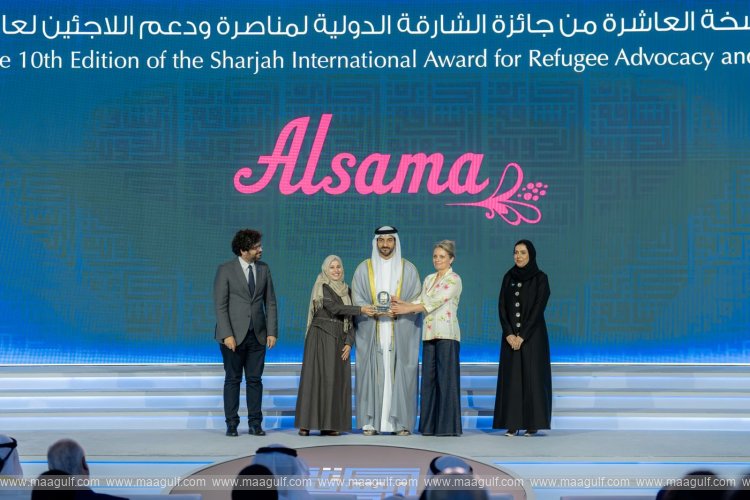
Sharjah: H.H. Sheikh Dr Sultan bin Ahmed bin Sultan Al Qasimi, Deputy Ruler of Sharjah and Humanitarian Envoy of The Big Heart Foundation (TBHF), presented the 10th Sharjah International Award for Refugee Advocacy and Support (SIARA) to Lebanon’s Alsama Project on Wednesday morning at Al Jawaher Reception and Convention Centre in Sharjah.
Selected from 736 nominations across 57 countries, Alsama received the AED 500,000 award for helping young refugees resume their education after displacement interrupted their schooling. Through its six-year accelerated programme, students who enrol unable to read or write can reach the equivalent of Grade 12 and apply to university.
The Big Heart Foundation organises the award in partnership with UNHCR, the UN Refugee Agency, under the patronage of His Highness Sheikh Dr Sultan bin Mohammed Al Qasimi, Supreme Council Member and Ruler of Sharjah, and his wife, H.H. Sheikha Jawaher bint Mohammed Al Qasimi, Chairperson of The Big Heart Foundation.
The ceremony opened with the UAE national anthem, followed by a film tracing the award’s history since its establishment in 2017. Over ten editions, SIARA has received more than 3,000 nominations from nearly 70 countries and honoured organisations working in education, healthcare, protection, social inclusion and livelihoods.
In her opening address, Mariam Al Hammadi, a member of The Big Heart Foundation’s Advisory Board, said that people forced to leave their homes, their schools and all that is familiar to them still carry their talents and ambitions with them. She said the loss extends beyond what a displaced person leaves behind. When someone is denied the chance to learn and pursue an ambition, the world also loses what that person might have contributed.
Al Hammadi said that, over the past decade, SIARA had introduced the world to organisations that found inventive ways to respond to the challenges refugees face. Some had helped children regain a sense of belonging after displacement, while others had found ways to safeguard their futures and bring communities together. “We have learned that humanitarian work is as much a field for innovation as it is for giving,” she said.
She said Alsama exemplified that approach. Its education model had given thousands of young refugees and displaced people the opportunity to return to learning and a greater say in what their future might hold. “The world needs more people who believe in a refugee’s right to life,” Al Hammadi said. “It also needs more people who believe in their right to shape that life and contribute to the world around them.”
Antón Leis García, UNHCR’s Assistant High Commissioner for Operations, said that more than one million people forced to flee their homes across Africa, Europe and Asia had received support through the agency’s partnership with The Big Heart Foundation. The partnership had helped them access education, healthcare and shelter, as well as opportunities to earn a living. He commended Alsama for helping young people whose schooling had been interrupted return to the classroom and gain the skills to support themselves.
Leis García also called for sustained support for humanitarian organisations working directly with refugees. “The dedication of these organisations reminds us that meaningful change often begins at the local level, with organisations that understand the needs and aspirations of the people they serve,” he said. “For their work to reach more people and have a lasting impact, they need partnerships backed by sustained support they can count on.”
Alsama co-founders Meike Ziervogel, Chief Executive Officer, and Kadria Hussein, Executive Director of Education Operations, described how students had shaped the programme from its beginnings in 2020, when Alsama worked with 40 Syrian refugee girls in Beirut’s Shatila camp.
“Our students are the inspiration behind our work,” Ziervogel said. “When they asked us for a proper education, we created a six-year accelerated learning programme. When they asked for a qualification equivalent to a secondary school certificate, we developed G12++ to meet international standards.”
Hussein recalled Wissal, a young woman from rural Deir ez-Zor in Syria, whose education had been disrupted by war and displacement. When she joined Alsama’s Shatila centre in 2020, Wissal could neither read nor write. Six years later, she graduated and moved to Canada to study psychology at York University. “For me, Wissal’s story is personal. We were with her every step of the way, from the day she learned her first letters to the day she started university,” Hussein said.
A panel titled Voices of Changemakers, moderated by Stanley Anigbogu of LightEd Impact Foundation, brought together Louay Alkadro of Alsama Project, Christina Ganeson of Dignity for Children Foundation and Ireri Shalon of RefuSHE. They spoke about the difference that access to education had made in their communities and how SIARA had helped their organisations improve their services and reach more people.
Edris Al Rafi, Chief Executive Officer of Invest Bank, the ceremony’s official sponsor, said the private sector shared responsibility with governments, humanitarian organisations and communities for supporting refugees. He paid tribute to Sharjah’s humanitarian work and to TBHF’s support for children’s education around the world.
“The most valuable assets may never appear on a balance sheet, and the highest returns cannot be measured in dirhams,” Al Rafi said. “The real return is a girl who once could not read her own name and can now write her own future.”
Before the ceremony, H.H. toured an exhibition of previously unpublished photographs and footage from the archives of the Media Office of the Sharjah Family and Community Council. The exhibition documented the humanitarian work of H.H. Sheikha Jawaher bint Mohammed Al Qasimi, Chairperson of the Council, including her visits to refugee communities to hear directly from families about their experiences and their efforts to rebuild their lives.
At a second exhibition, H.H. was briefed on Alsama’s five education centres in Beirut and Homs. Ninety per cent of students could neither read nor write when they enrolled, and most acquired basic literacy within six months. Four centres hold accreditation from the Western Association of Schools and Colleges, with the Shatila 1 centre accredited through Grade 12.
Alsama developed the G12++ qualification so that displaced students could demonstrate their academic attainment and skills to universities, training providers and employers. It aims to reach 5,000 candidates by 2030. Alongside their studies, students play cricket to build confidence, develop leadership skills and learn to work as a team.
Of the 16 Alsama graduates who have progressed to higher education, 13 have enrolled at universities in Canada, the United Kingdom, India and Lebanon. Three are continuing their studies online through Cambridge PACE.
At the close of the ceremony, His Highness joined representatives of Alsama and previous award recipients for commemorative photographs.

తాజా వార్తలు
- అజ్మాన్ ప్రభుత్వ ఉద్యోగులకు డిసెంబర్ 2 నుంచి 4 వరకు ఈద్ అల్ ఎతిహాద్ సెలవులు
- దుబాయ్ ఇంటర్నేషనల్ బోట్ షో ప్రారంభించిన షేక్ మన్సూర్ బిన్ మహమ్మద్
- దేశంలోనే తొలిసారిగా ఏఐ ఆధారిత పోలీస్ స్టేషన్.. పంజాగుట్టలో పైలట్ ప్రాజెక్టు
- 14 దేశాల పై అమెరికా సుంకాల మోత..
- అబుదాబి–కొచ్చి ఇండిగో విమానంలో ప్రయాణికుడి పై దాడి.. వ్యక్తి అరెస్ట్
- నాలుగో ప్రపంచ తెలుగు మహాసభలకు సీఎం చంద్రబాబుకు ఆహ్వానం
- కవిత బరిలోకి దిగేది ఆ అసెంబ్లీ స్థానం నుండే !!
- కువైట్లో గొర్రెల పెంపకందారులకు డిసెంబర్ 31 వరకు గడువు..!!
- ఒమన్లో ప్రారంభమైన ముత్రా కేబుల్ కార్..!!
- పలు కీలక రంగాల్లో ఖతార్–అమెరికా ఒప్పందాలు..!!


