
Sharjah Ruler inaugurates Fili Fort
- February 16, 2026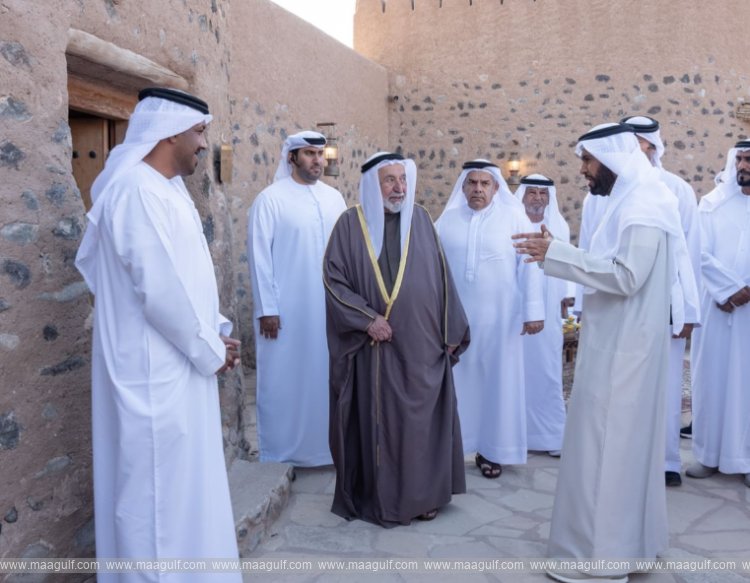
Sharjah: His Highness Sheikh Dr. Sultan bin Mohammed Al Qasimi, Supreme Council Member and Ruler of Sharjah, inaugurated on Sunday morning Fili Fort following restoration works and the revival of the area as part of the “Fili Heritage” project.
H.H. Sheikh Dr. Sultan arrived at the Fili area via the new Road, which was constructed to link Al Watan Road (E84) in Mleiha with Fili Fort in the Al Madam area, extending approximately 5.5 kilometres. This provides residents and visitors with easier access to their destinations, enhances traffic flow, and improves the efficiency of movement and transport in the area.
Upon his arrival, H.H. Sheikh Dr. Sultan was received with performances by traditional folk troupes amid a warm welcome from local dignitaries. He then unveiled the commemorative plaque, marking the official reopening of the fort after its restoration.
The Ruler of Sharjah graciously received the certificate of registration of Fili Fort in 2024 on the Heritage List in the Islamic World of the Islamic World Educational, Scientific and Cultural Organization (ICESCO). This reflects the Emirate of Sharjah’s commitment to preserving, safeguarding, and sustaining its cultural heritage as an authentic part of the emirate’s and the United Arab Emirates’ civilisational identity.
H.H. Sheikh Dr. Sultan toured the fort, which includes a defensive tower and multi-purpose rooms serving functions such as surveillance, storage, and reception, within an architectural system that combines security and social roles.
The fort contains a room narrating the story of caravan routes, where Fili emerged as a main station for rest and replenishment with water and food along the passage routes between the coast and the interior. Benefiting from its central location and the abundance of falaj water, it became a safe stop for trade caravans. The fort also displays a rare collection of copper coins dating back to the nineteenth century, along with distinctive archaeological finds such as a dallah lid and a coffee cup believed to date to the second half of the eighteenth century or the early nineteenth century, indicating the depth of commercial activity and daily life in the region.
The fort includes a dedicated falaj room that offers visitors an interactive experience through a model simulating the method of excavating and constructing the Dawoodi falaj and the mechanism for distributing water to farms, highlighting Fili’s connection to agriculture and the sustainability of life there. There is also a weapons room displaying traditional arms used in the area, such as rifles, matchlock guns, al-sum‘ah, daggers, local swords, katara swords, sickles, axes, and wood chisels. The fort further presents falconry and equestrian tools, including saddles and falcon training equipment, underscoring their place in local heritage and their role in hunting and mobility.
The date-syrup room within the fort stands out as an important economic feature, illustrating the stages of preserving and producing date syrup from well-known local varieties such as Shishi, Sagai, Khalas, and Nagaal, using traditional tools, indicating the importance of dates as a primary source of food and a pillar of food security in the past.
The fort also includes a traditional kitchen section displaying Emirati cooking utensils such as copper pots, ladles, cauldrons, tongs, the clay oven (tandoor), the hand-mill for grinding grains, the fan used to ventilate the fire, copper trays, and coffee-making tools. The section demonstrates traditional cooking methods that relied on firewood and direct heat, such as preparing harees, cooking rice and meat, and baking regag bread, embodying the spirit of generosity and hospitality associated with the Emirati kitchen.
The fort contains a guard’s room that embodies the fort’s security role, through the display of the guard’s clothing and weapons and an explanation of his duties in surveillance and alerting. At the centre of the fort is an internal courtyard that formed the heart of daily activity, including a walkway for soldiers designated for organising patrols and guard movements. It also houses the Bab Al Sabah Gate, made of thick wood reinforced with nails and iron plates, and fixed within a solid mud-stone frame.
The restoration works of the fort and the falaj were completed in accordance with the highest internationally approved standards for the conservation of heritage buildings, through adherence to traditional methods and original construction materials, thereby preserving the site’s identity and historical value.
Fili Fort represents a witness to an important stage in the history of settlement and fortification in the Central Region, as it was built from rammed mud (mud brick) and local stones, with the use of palm trunks and fronds for the roofs, and traditional plaster for fixing and protection, in a sincere reflection of Fili’s agricultural environment and resources.
As part of the restoration works, one of the simple dwellings, consisting of a single room, was restored to establish the heritage house next to Fili Fort, in the authentic architectural style of the area. The house is considered a traditional cultural museum that embodies the lifestyle and customs that prevailed among previous generations, particularly crafts for which women were known, such as talli embroidery and sadu weaving.
The house includes traditional furnishings reflecting the simplicity of life at that time, such as mats and floor coverings, cotton mattresses, the mandoos chest for storing belongings, the wooden bed, lanterns and others, in addition to incense burners, coffee-making tools, cooking utensils, and dishes displaying types of spices and herbs that were used for cooking and treatment. Some traditional women’s adornment items are also displayed, such as the kohl container and kohl stick, the incense burner, perfume bottles, the marash sprinkler, and the burqa, indicating the presence of beauty and incense in the details of daily life within the traditional Emirati home.
A heritage café was also established next to Fili Fort on an area of 240 square metres, offering a unique experience that blends the authenticity of classical architecture with features of contemporary comfort, through its traditional façades, hand-crafted wooden details, and classical design elements that reflect the spirit of architectural heritage.
The Ruler of Sharjah also visited Fili Falaj and its Sharia’t (water access point). The falaj is considered an integrated model of the Dawoodi falaj and one of the most prominent falaj systems, distinguished by high engineering precision and an effective ability to utilise groundwater sustainably. Fili Falaj relies on a network of long, gently sloping tunnels extending beneath the ground surface, which transport water from underground reservoirs to the surface. The falaj extends approximately 1.5 kilometres and includes more than 40 vertical wells, reflecting the scale of the engineering effort expended in its construction. The restoration of the historic falaj included the use of stone and fired clay without introducing any modern materials, which contributed to restoring the water flow after an interruption that lasted for years.
The Sharia’t and the farms irrigated by the falaj were also rehabilitated, reflecting the sustainability of agricultural activity which in the past formed a fundamental pillar of life in the region. The establishment of the falaj dates back more than five centuries, specifically to the sixteenth century AD, when it was constructed through the efforts of the sons of the Bani Jaber tribe to serve as a source of life and growth in the area.
The falaj system was based on precise principles that ensured fairness in distributing water among farmers. Shares were measured by a time unit known as the “athar”, estimated at around half an hour. During the day, it was determined using a sundial by tracking the movement of the shadow, with the possibility of adjusting it according to variations in daylight hours throughout the seasons of the year. At night, other methods were used, such as calculating the positions of the stars or the “water bowl”, a perforated metal vessel that represents the time it takes to fill and sink as one time unit (athar).
Falaj water reaches the Sharia’t, which is the point where water emerges to the surface and where its public distribution begins. It flows through open channels to irrigate farms, palm trees, and crops. The Sharia’t serves as the centre for organising the distribution process, from which the mechanism of dividing shares begins according to the approved time-based system, in a manner that reflects the integration between the engineering infrastructure extending underground and the management system operating above it.
The falaj witnessed two prominent phases of restoration: the first in the 1960s during the era of the late Khalid bin Mohammed Al Qasimi, and the second in 2026 during the era of H.H. Sheikh Dr Sultan bin Mohammed Al Qasimi, with the aim of preserving this engineering masterpiece, reviving it, and ensuring its continuity as an authentic part of the region’s water and agricultural heritage, so that Fili Falaj remains a living witness to a long history of innovation in water management and agricultural sustainability in Fili.
The area includes the heritage farm, consisting of palm plantations and aromatic plants, which aims to revive Fili Falaj and its Sharia’t and to reconnect visitors with the historical role of water in supporting agriculture and settlement in the region. The farm also seeks to cultivate various varieties of palm trees representing the different date harvest seasons in the United Arab Emirates, allowing visitors to experience the agricultural season in all its stages from beginning to end.
The area includes the heritage farm, consisting of palm plantations and aromatic plants, which aims to revive Fili Falaj and its Sharia’t and to reconnect visitors with the historical role of water in supporting agriculture and settlement in the region. The farm also seeks to cultivate various varieties of palm trees representing the different date harvest seasons in the United Arab Emirates, allowing visitors to experience the agricultural season in all its stages from beginning to end.
Around the fort and the Sharia’t, a range of facilities and services has been provided that contribute to reviving “Fili Heritage”, including dedicated visitor parking. The Sharia’t area includes 25 parking spaces, while the surroundings of the fort contain 44 spaces, ensuring ease of access and smooth movement at the site.
Fili Heritage Road was developed within an 18-metre-wide right-of-way to be a single lane in each direction. The route begins from the roundabout at Exit 34 on Al Watan Road and extends smoothly to Fili Heritage. The design of the straight route took into account compatibility with the future master plan, while following the natural topography of the site and achieving a precise balance between cutting and filling works in order to preserve the existing landscape.
Three drainage culverts and three surface crossings were also constructed to ensure effective and safe rainwater management, allowing floodwaters to pass in an organised manner while maintaining uninterrupted traffic flow. Essential utility services were installed and pipeline ducts were extended beneath the road in support of future expansion plans and service integration. Approximately 135 lighting poles were also installed along the road to enhance traffic safety and night-time visibility, ensuring safe movement and good illumination during the night hours.
Accompanying the Ruler of Sharjah during the inauguration were Sheikh Majid bin Sultan Al Qasimi, Chairman of the Districts Affairs Department; Sheikh Dr Khalid bin Humaid bin Saqr Al Qasimi, Chairman of the Sharjah Sports Council; Sheikh Hamad bin Hamdan Al Nahyan; Abdulrahman Mohammed Al Owais, Minister of Federal National Council Affairs; along with a number of senior officials and dignitaries of the region.

తాజా వార్తలు
- అక్టోబర్ 20 వరకు సౌదీ అరేబియాకు ఎయిర్ ఇండియా, ఎయిర్ ఇండియా ఎక్స్ప్రెస్ విమానాలు రద్దు
- దుబాయ్లో IIFA ఇన్సైడర్ ఎడిషన్–2.. నోరా ఫతేహీతో సినీ, సోషల్ మీడియా ప్రముఖుల సందడి!
- మిడిల్ ఈస్ట్ లో ఉద్రిక్తతలు..హౌతీ దాడులను అడ్డుకున్న సౌదీ అరేబియా
- నకిలీ డ్రైవింగ్ లైసెన్స్ల ముఠా గుట్టురట్టు.. 8 మంది అరెస్ట్
- ‘జనసేన గ్రాడ్యుయేట్ ఎక్స్ప్రెస్’ను ప్రారంభించిన పవన్ కల్యాణ్
- విమానాల మార్పుల కోసం జీఎంఆర్ ఏరో టెక్నిక్–లాజిక్ ఎయిర్ ఒప్పందం
- భారత్-యూఏఈ సంబంధాల బలోపేతం పై జైశంకర్ చర్చలు..రాస్ అల్ ఖైమా రూలర్ తో భేటీ
- విజయవాడలో ఎన్టీఆర్ ట్రస్ట్ నూతన భవనం.. ప్రారంభించిన నారా భువనేశ్వరి
- ఖతార్లో అక్రమ వీసా వ్యాపారంపై హెచ్చరిక..!!
- ఒమన్లో 17 పెట్రోల్ బంకులకు జరిమానాలు..!!


